Equivalence principle
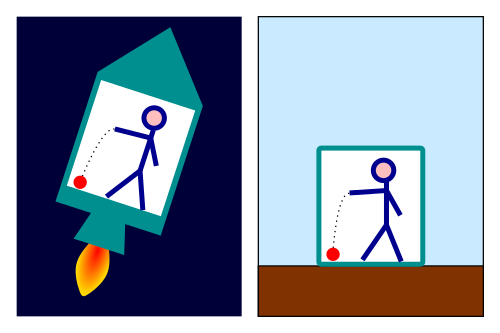
The equivalence principle is the hypothesis that the observed equivalence of gravitational and inertial mass is a consequence of nature.
Commentary
Commentary
Equivalence principle
The equivalence principle is the hypothesis that the observed equivalence of gravitational and inertial mass is a consequence of nature.
Why does Equivalence principle matter?
This principle is one of the building blocks physicists use to explain the world. Without it, a whole class of phenomena would have no mathematical description. Engineers, chemists, and astronomers all rely on it.
Background: Equivalence principle
The equivalence principle is the hypothesis that the observed equivalence of gravitational and inertial mass is a consequence of nature. The weak form, known for centuries, relates to masses of any composition in free fall taking the same trajectories and landing at identical times. The extended form by Albert Einstein requires special relativity to also hold in free fall and requires the weak equivalence to be valid everywhere. This form was a critical input for the development of the theory of general relativity. The strong form requires Einstein's form to work for stellar objects. Highly precise experimental tests of the principle limit possible deviations from equivalence to be very small.
Sources: Wikipedia
FREE DAILY EMAIL
Get it in your inbox
One short, ad-free email each morning. Always free, unsubscribe anytime.
Commentary
Commentary